

Champion at eleven: the rise of Bodhana Sivanandan
On Sunday 9 August, at the University of Warwick, an 11-year-old from Harrow sat down for a rapid playoff with the British women’s title on the line. Two games later, Bodhana Sivanandan was the youngest British women’s chess champion in the title’s history — and the commentary box had already run out of superlatives. “Unreal! Bodhana has won,” said Grandmaster Danny Gormally on the English Chess Federation’s broadcast. “She is unbelievable, a generational talent.”
She is eleven years and five months old. The record she broke had stood since 1939, when Elaine Saunders won the title at thirteen.
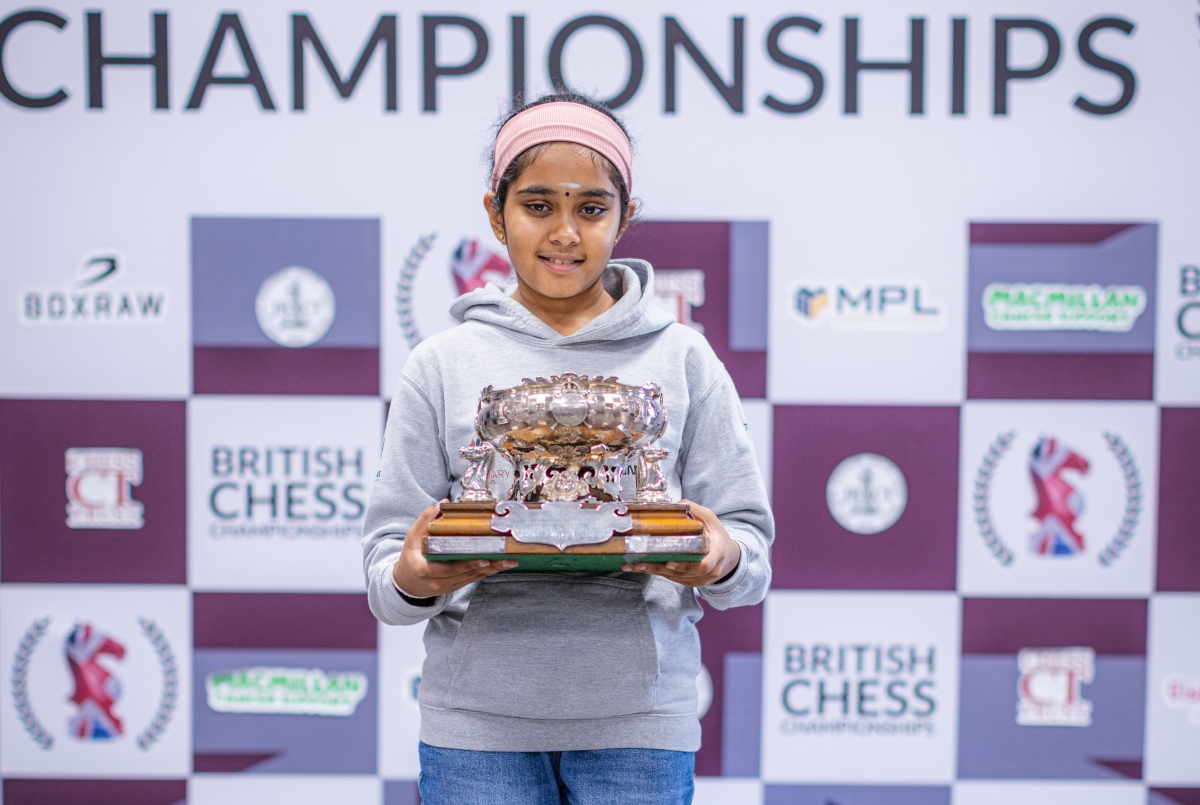
The youngest British women’s champion in history, with the silverware to prove it. Photo: Yury Krylov, ECF Home Chess Development Director.
If you don’t follow chess closely, you may not have heard of Bodhana yet. You will. Here is her story so far — and what it says about where English chess, measurably booming, is heading.
From a lockdown chess set
Bodhana Sivanandan was born in London in March 2015; her parents had moved to the UK from Tiruchirappalli in Tamil Nadu, and the family settled in Harrow. When the pandemic hit she was five. A friend of her father’s, returning to India, left some bags of belongings with the family — and in one of them was a chess set. She started moving the pieces to pass the lockdown days.
Five years later, the results read like a misprint:
- 2022, aged 7 — won all 24 of her games at the European Schools Championships in Rhodes, taking three gold medals. Grandmaster Keith Arkell, who played her that year, said afterwards: “I won only because of her inexperience.”
- 2023, aged 8 — became triple World Under-8 champion (classical, rapid and blitz), England’s first world youth champion in a quarter of a century. She won all 32 games.
- 2024, aged 9 — selected for England’s women’s team at the Chess Olympiad in Budapest, believed to be the youngest person ever to represent England internationally in any sport.
- 2025, aged 10 — beat Grandmaster Peter Wells at the British Championships in Liverpool, becoming the youngest female player ever to beat a grandmaster in classical chess, and completed her Woman International Master title, again the youngest ever. That autumn she beat Mariya Muzychuk — a former women’s world champion.
- 2026, aged 11 — gained 203 rating points in a single month; became Britain’s No. 1 female player on the April rating list and entered the women’s world top 100; scored her first International Master norm in France in July, the youngest girl ever to do so; and then won the British women’s title.
Along the way she has played chess in the Downing Street garden — the former Prime Minister reported that her success “has not come as a shock” to him — and given the Mayor of Harrow a game. English chess’s governing body is not given to hyperbole, but its chief executive Richard Walsh put it plainly this spring: “She is blazing a trail not just for women and girls in the game, but for all chess players in England.”
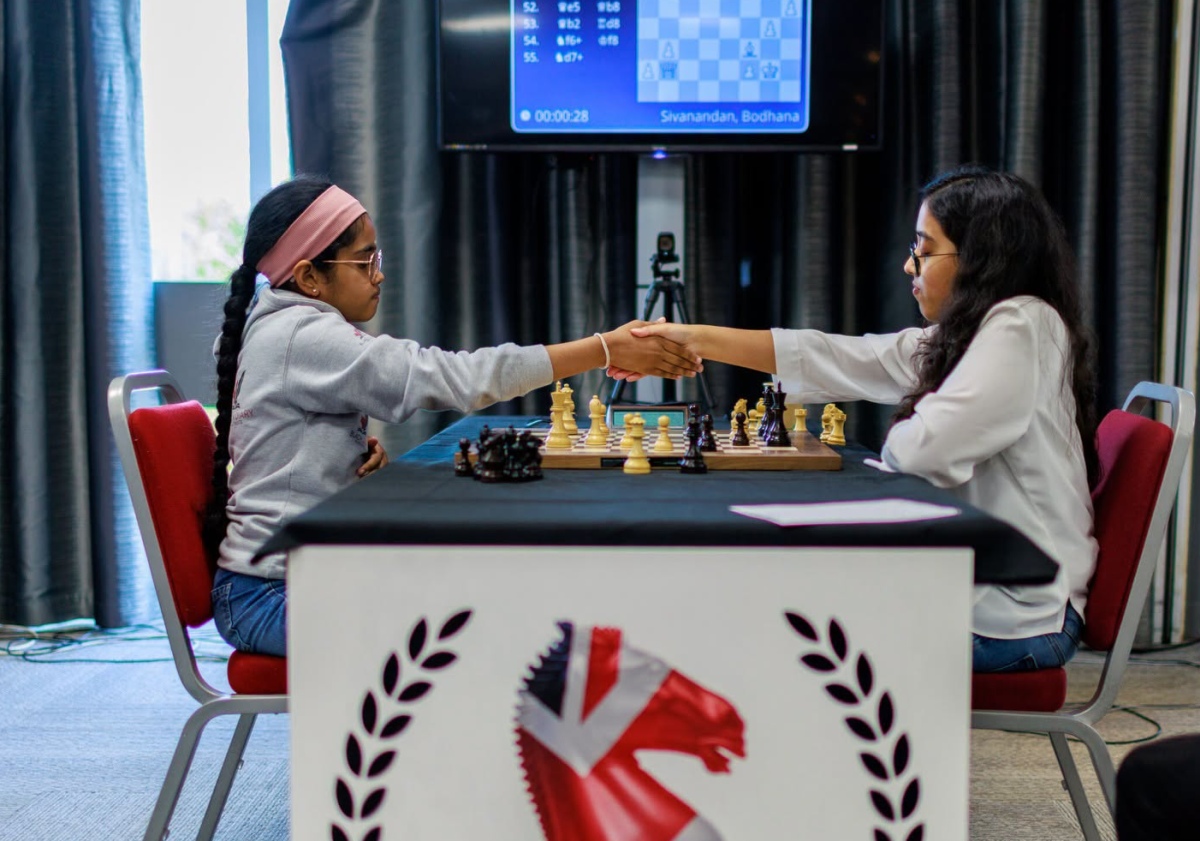
The moment the title was decided: the playoff against 14-year-old WGM Trisha Kanyamarala. Photo: Yury Krylov, ECF Home Chess Development Director.
At Warwick she scored 5½ from 9 rounds in the open championship field, including a win over Grandmaster Ameet Ghasi that the engines reportedly scored at 99% accuracy, before winning the playoff 1½–½ against 14-year-old WGM Trisha Kanyamarala. Fittingly, the same week produced the youngest-ever open British champion too: 17-year-old Grandmaster Shreyas Royal — who happens to be the only player who beat Bodhana all fortnight. The two youngest champions in the event’s 122-year history, crowned at the same record-breaking championships. British chess has never seen a week like it.
Not a boys’ game
For most of the last century, competitive chess in England has looked overwhelmingly male. That is changing, and not only at the top. Our UK chess statistics page tracks every ECF rating list back to 1994: the female share of England’s rated players, stuck below one in ten for decades, has been climbing steadily since 2023 — and among the youngest juniors the picture is transformed, with girls making up roughly a fifth of the ECF’s under-12 members. The women’s prize fund at this year’s British Championships was more than doubled.
The research on girls’ chess is clear that the barrier has never been ability — it is that girls historically drifted away from the competitive game in their teens. What changes that, more than anything, is visible proof of what is possible. English girls picking up a chess set this year have that proof, aged eleven, on the front pages.
Bodhana and Judit
No conversation about women’s chess gets far without Judit Polgár — the strongest female player in history, a grandmaster at 15 (breaking Bobby Fischer’s youngest-ever record), a Kasparov-beater, world No. 8 at her peak, and the world’s top-ranked woman for 26 unbroken years.
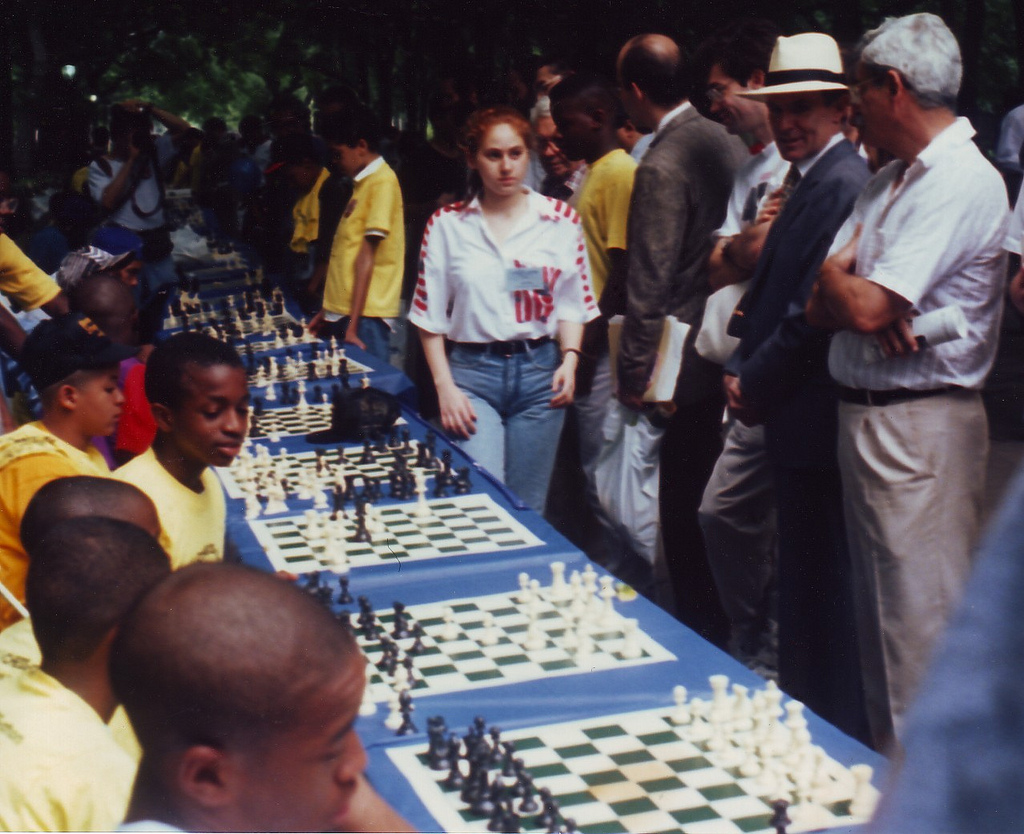
Eleven years old, taking on all comers: Judit Polgár giving a simultaneous display in Central Park, New York, in July 1988 — the year she set the two records that Bodhana, eleven herself, has just taken from her. Photo: R. Cottrell, CC BY-SA 3.0, via Wikimedia Commons.

Their paths have already crossed, memorably. During the Budapest Olympiad in September 2024, Polgár hosted the then nine-year-old for a day-long masterclass at her chess centre — blindfold puzzles included — and gave her a piece of advice worth framing: “You have to play with the players who give you the best and biggest challenges. That’s how you can improve your chess.” Days later, at Polgár’s own Global Chess Festival, Bodhana turned out in a community simultaneous display against her host, found the defensive resource that saved her team’s game, and drew. Polgár’s verdict afterwards: “Maybe the most interesting game was the News Navigators — but that was with a little help from Bodhana.”
Then came this summer’s twist. The records Bodhana broke in July — youngest girl to score an IM norm, youngest girl to beat a 2600-rated grandmaster — had belonged to one player since 1988: Judit Polgár. The torch is not being passed so much as sprinted after.
What next, at eleven?
Asked in Budapest about her ambitions, Bodhana’s answer had no hedge in it: “I want to become a world champion and one of the greatest players in the world.”
The staging posts are visible enough — the remaining International Master norms to go with July’s first, the Woman Grandmaster title her two norms already point towards, and in time a place in the world championship cycle. Every age record in front of her currently has an illustrious name against it, and on current evidence you would not bet against any of them. Perhaps the most remarkable thing of all, though, is the bit that isn’t extraordinary: she is eleven, and she is still at primary-school age for a few more weeks of it. The story is only just beginning.
Feeling inspired?
You do not need a prodigy in the family to be part of this. If Bodhana’s story has you — or a child in your life — curious about the game, two links of ours are the place to start: Junior Chess in Kent, a parent’s guide covers school clubs, junior nights and how children’s ratings work, and Join Us has everything about our own Monday evenings in Tunbridge Wells, where all ages and abilities are genuinely welcome. The next Bodhana is out there somewhere, five years old, about to find a chess set in a bag. It might as well be in Kent.